Holding Change Assessments
Developed in partnership with expert researcher Zuri Tai, these tools can help people understand where they are related to a set of skills or conditions. Included is a facilitation self-assessment, a co-facilitation assessment, facilitation intake questions, and a mediation assessment.
A process to help you assess your group’s culture, functionality, emergent strategy capacity, purpose, and the presence of power dynamics.
Developed in partnership with expert researcher Zuri Tai, these tools can help people understand where they are related to a set of skills or conditions. Included is a facilitation self-assessment, a co-facilitation assessment, facilitation intake questions, and a mediation assessment.


A process to help you assess your group’s culture, functionality, emergent strategy capacity, purpose, and the presence of power dynamics.
Holding Change Assessments
Developed in partnership with expert researcher Zuri Tai, these tools can help people understand where they are related to a set of skills or conditions. Included is a facilitation self-assessment, a co-facilitation assessment, facilitation intake questions, and a mediation assessment.
In Emergent Strategy there’s a set of assessments that I created myself. They do the job, but even as I was creating them, I was aware of my limitations: surely there was a better way to create tools that people can use to understand where they are related to a set of skills or conditions. I considered reaching out to my expert researcher friend Zuri Tai to help, but by the time I realized I wanted that, it was too late in the journey.
Fortunately, this time, Zuri was available when I remembered the assessments for this book, and my, my, my does she have a gift for community-based research. Zuri did a beautiful job translating my chaos of questions into a process that will help you assess your group’s culture, functionality, emergent strategy capacity, purpose, and the presence of power dynamics. There is also a facilitation self-assessment, a co-facilitation assessment, facilitation intake questions, and a mediation assessment.
Group Assessments
.png)
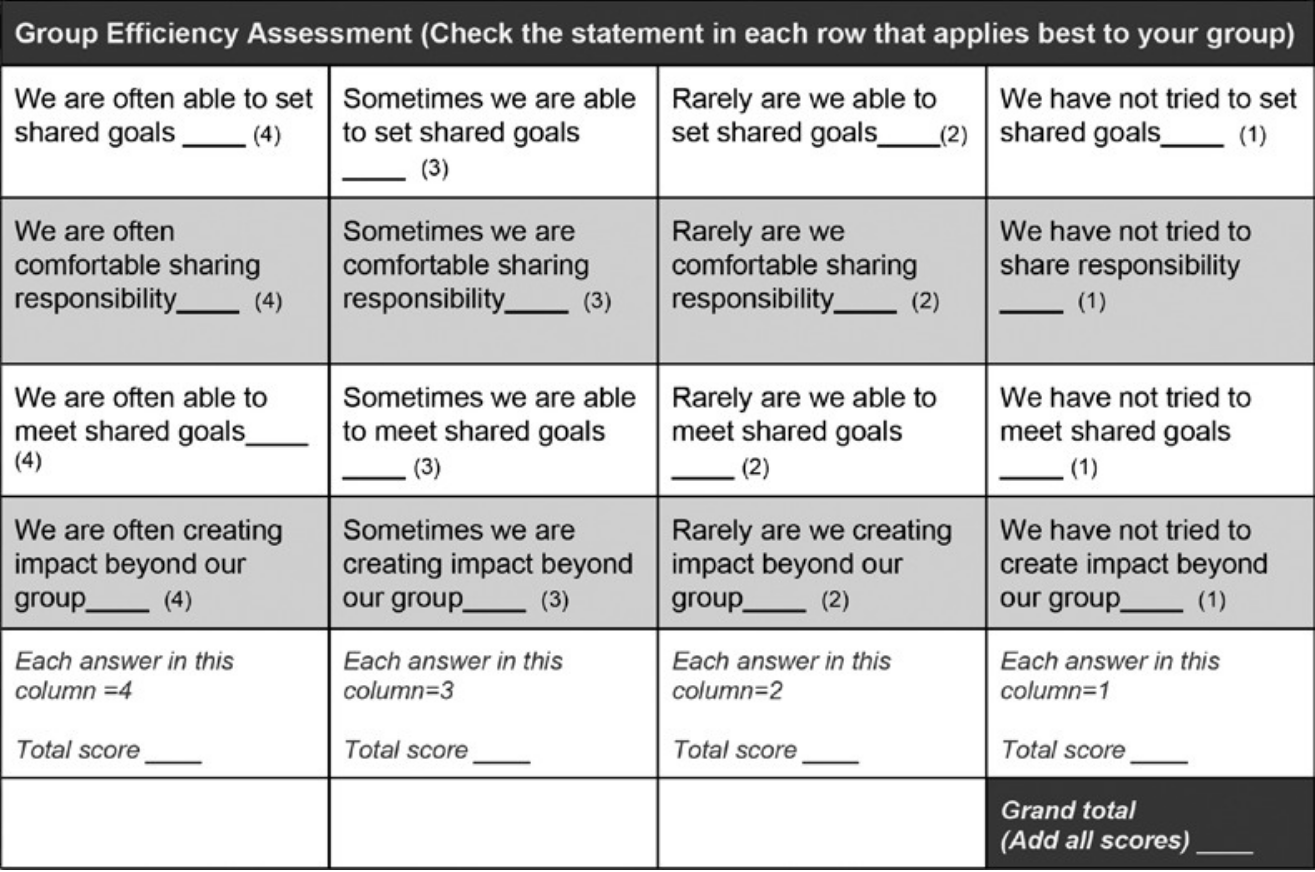
Write the grand total for the two assessments:_______ Efficiency_______ Relationship______
A. high efficiency (score: 12–16), high relationship (score: 12–16)
These groups are exhibiting peak collective function, contributing to a clear mission and meeting goals. We can count on each other, trust each other, and enjoy each other.
B. low efficiency (score: 4–11), high relationship (score: 12–16)
These groups are survival bonded. We stay together, enjoy and maybe even love each other, but may not meet our stated goal or purpose.
C. high efficiency (score: 12–16), low relationship (score: 4–11)
These groups often form in response to a crisis. We get shit done but aren’t sure we are all moving from the same intentions or if the outcomes are meaningful. The relationships feel temporary and people eventually get hurt.
D. low efficiency (score: 4–11), low relationship (score: 4–11)
Not accomplishing much for or beyond the group; gathering may be a coping mechanism because we don’t want to be alone. Gathering is dysfunctional and lacks joy.
For high efficiency/high relationship read the Black Feminist Wisdom chapter
For low efficiency/high relationship scores read Creating More Possibilities, p. 178
For high efficiency/low relationship scores read Fractal Facilitation, p. 100
For low efficiency/low relationship scores read Interdependent/Decentralized Facilitation, p. 134
Group Function Assessment
1. How often do they need breaks?
- ____ Every 60-90 minutes, often after a piece of work is completed or reaches the satisfaction of a next step
- ____ Every 30-60 minutes, and conversation is easily moved into tangents
- ____ Never, or need to be reminded that breaks are an option
- ____ Right when the group is on the verge of taking action or landing a decision
2. What do they use their breaks for?
- ____ Bathroom, snacks, connecting to each other personally, deepening the work in the room
- ____ Talking to each other, doing work on other projects, second guessing the work that’s moving in the room
- ____ Work. You have to remind them to use bathroom and go outside of the meeting space
- ____ Fomenting dissent or disillusionment
3. What is the tone in the room when disagreement arises?
- ____ Competent, turning towards it with solution mind
- ____ Fear of conflict, resistance to name what’s going on
- ____ Unemotional, pushing for quick resolution that doesn’t go to the root of the issue
- ____ Avoidance, checking out
4. How do they move through disagreements?
- ____ With integrity, attending to necessary root systems of the conflict but not wasting time
- ____ Struggle to stick to political lines, make arguments personal
- ____ Stick to the surface issues, rush to move things along in ways that leave issues to fester
- ____ Struggling to speak the truth in the room, lots of side conversations
5. Are they dysfunctionally high in session? Or show up late after nights of partying?
- ____ Rarely, and/or collectively after big moments of work
- ____ Often, struggling to be present for the work
- ____ No, and they judge each other for any signs of fun or coping
- ____ They aren’t present enough to tell what is causing the low participation
6. Do they follow through on tasks and commitments?
- ____ Yes, they are accountable to each other
- ____ No, but they talk about the reasons why
- ____ Yes, but with conflict in how the tasks are done, working competitively instead of collaboratively
- ____ No, tasks seem to disappear into a black hole
7. Are the power dynamics clear in the room? (Who has power? How did they get it?)
- ____ Yes. The power dynamics are clear and the group is comfortable with them.
- ____ Not quite—there’s a story that power is fully shared.
- ____ Yes, but people don’t think it’s necessarily fair, or know how to change it.
- ____ No, and the power that is in the room is used to delay action rather than move it.
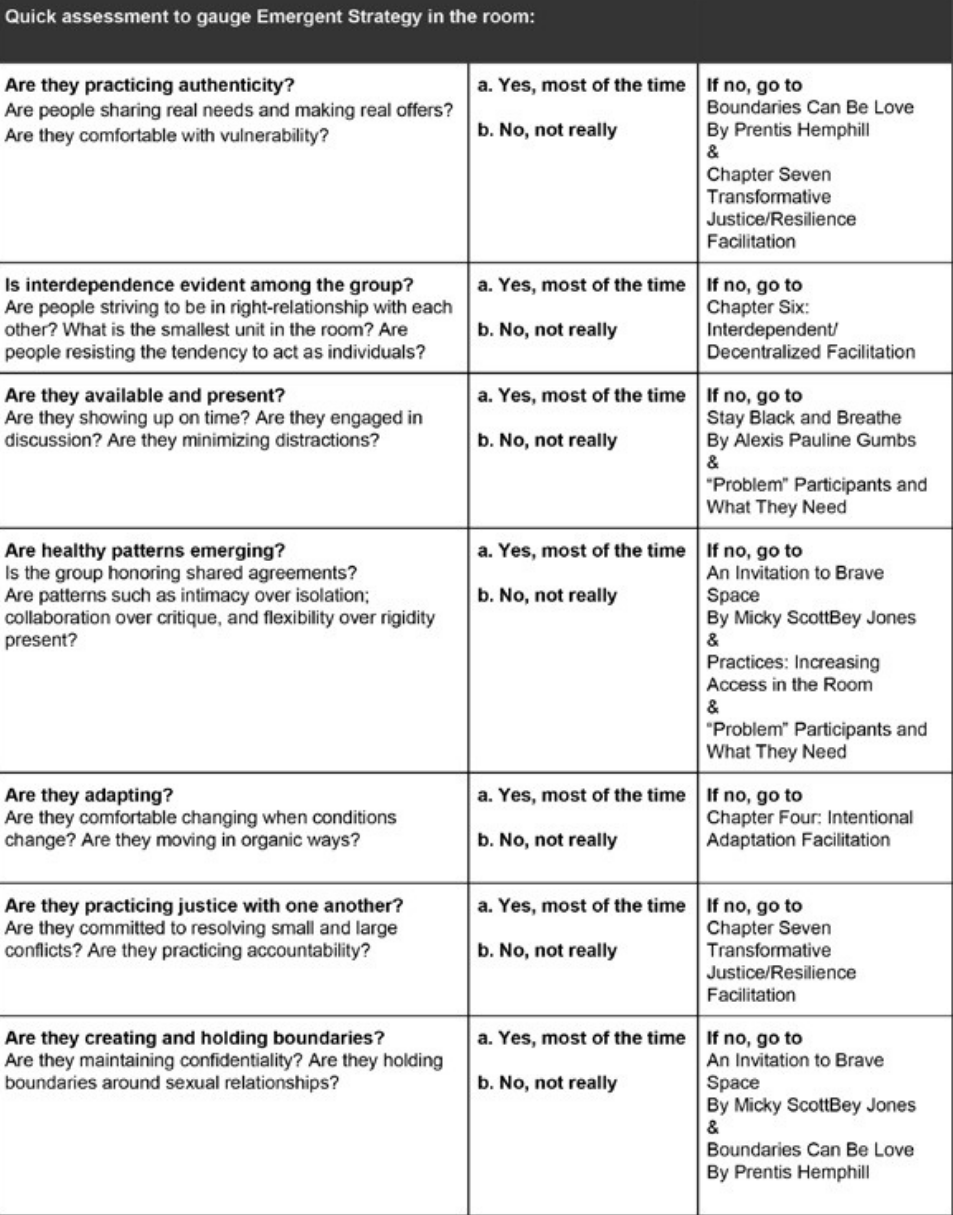
Count the number of a’s_______ ; of b’s_______ ; of c’s_______; of d’s_______
If you selected mostly a’s then you’re working with an engaged group. They use emergent practices, are usually present, in high relationship with each other and have a clear understanding of power and boundaries.
If you selected mostly b’s then you’re working with a resistant group. They are often second-guessing the work and prone to conflict or getting stuck and distracted. They are in low relationship with each other. They may have high energy but low focus, and are unclear on the power relations and boundaries in the group.
If you selected mostly c’s then you’re working in a driven group. They are task oriented and likely have short-term high focus. They are usually in low relationship, yet may be able to move work forward. However they lack emergent practices and clear understanding of how to negotiate power and boundaries.
If you selected mostly d’s then you’re working in an avoidant group. They are more likely to spend energy debating or ruminating about what should be done than actually doing any work. They are usually in low relationship with each other and lack an understanding of how power is playing out in the group. Boundaries are often ignored.
Additional Group Assessments


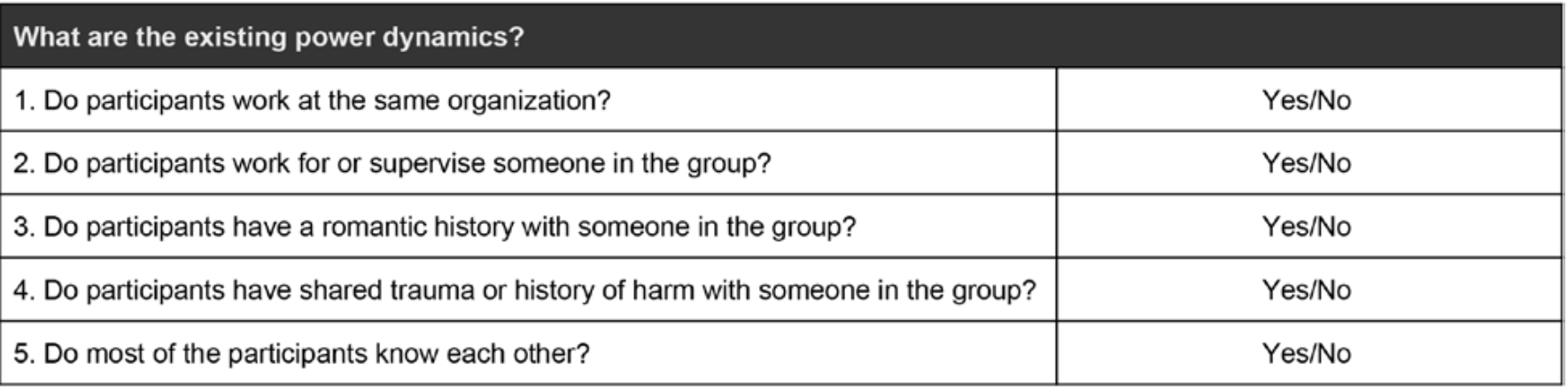
If you answered yes to any of these questions, then take time to consider the power relations that people are engaging in that pre-date the group and are outside of your control.
Read the “What Is Principled Struggle?” section of the next chapter.
Facilitator Assessments
Elements in Facilitation Self-Assessment/Journaling:
The Self-Assessment is a tool to deepen your understanding of your facilitation approach These questions can be used in a journaling practice or before you do the following co-facilitation assessment. It will be helpful to revisit these questions and your answers on a regular basis.
- How do I orient myself to small changes and successes?
- How have I adapted to change in my own life?
- Am I comfortable trusting someone else to hold space with me? Why or why not?
- Am I comfortable facilitating groups when the conditions change? Why or why not?
- What are the main practices I bring to my facilitation?
- How do I orient to shared power? (What feedback have those I’ve shared power with given me?)
- What resilience practices am I in?
- How do I bring my focus to solutions?
- In what ways am I right for this group? Do I share identity, experience, culture, capacity, and/or economics?
- In what ways am I wrong for this group? Do I have dissimilar identity, experience, culture, capacity, and/or economics?
Co-Facilitation Assessment Questions (For A Conversation With A Potential Co-Facilitator):
The Co-Facilitation Assessment is a tool to deepen understanding and maintain communication between facilitators. These questions can be asked at the beginning of the relationship and revisited regularly.
This assessment will help you understand how to communicate well with each other; how you approach facilitation; how you handle conflict; and how you manage clients.
- Your facilitation approach
- How do you understand the work of facilitation?
- How do you usually show up in your facilitation role?
- What is your capacity to facilitate in this season? (Are you busy? Balancing a lot?)
- What helps you show up as your best in a facilitation partnership?
- What hinders you from showing up as your best in a facilitation partnership?
- How would you handle it if I did something you didn’t agree with during our facilitation?
- If there is a breakdown how do you respond, cope, and provide support?
- Communication
- How will I know when you are not pleased?
- How will I know when you are satisfied?
- How do you know when you’re overwhelmed? How might you communicate that to me?
- What happens when your capacity shifts (grows or lessens)? How might you communicate that to me?
- Organization & Practices
- What is your process for understanding the facilitation landscape with a new client?
- How do you build your agendas?
- How do you handle booking, scheduling, billing, late payments, etc.?
- History
- Have you been in a co-facilitation relationship before?
- What did you like about it? What didn’t you like about it?
- Have you worked with this client, or any of the individuals in this group, before?
Assessment Questions for Potential Facilitation Clients
- Why? Questions
- Why this? Why are we having this meeting/gathering/ conversation?
- Why now? Why is this conversation needed now?
- Why us? Why are we the right people to call in this gathering?
- Why does it matter? Why is this relevant?
- Who? Questions
- Who are we accountable to?
- Who grows us?
- Who is actually down to do the work?
- Who has the skills we need?
- How? Questions
- How will we be in this process?
- How will this have an impact?
- How can we embody our values?
- When? Questions
- When is this work needed by?
- When can we start?
- When will we be finished?
- What? Questions
- What can we do together?
- What excites and enlivens us?
- What will serve our people?
- What is at the root of our work?
Mediation Assessment
